Persistent agent memory for cross-tool localization and development
ALMA-memory (Agent Learning Memory Architecture) by RBKunnela is a persistent memory server that gives AI agents long-term context for tasks such as text localization and software development. It stores and ranks past interactions, applies a four-factor retrieval score, and records anti-patterns to reduce repeat errors. Key capabilities include Veritas trust scoring, multi-backend database support, and native Model Context Protocol integration. The tool targets AI developers and localization engineers who need consistent terminology and remembered decisions across MCP-enabled tools.
What tasks can you actually use ALMA for?
ALMA acts as a cognitive layer that preserves session context and prior decisions for agents working on iterative tasks. The server stores localization terminology, style guides, and prior translation choices so those facts remain available across separate agent sessions. That persistent memory pool survives between tools, allowing an agent in one MCP-enabled client to access knowledge generated by another.
How reliable are the memories and retrievals?
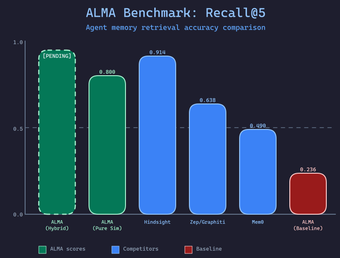
The tool ranks and injects memories using a defined scoring method rather than simple vector similarity, which affects retrieval quality. ALMA uses a four-factor retrieval score and a trust rank to prefer high-quality entries, and it records anti-patterns to block repeated mistakes. The scoring factors are:
- semantic similarity
- recency
- previous success rate
- confidence level
What inputs and environments does it require?
ALMA runs wherever the Model Context Protocol is supported and offers SDKs for common stacks, so integration requires MCP-compatible clients. The core framework requires Python 3.10+ or a Node.js/TypeScript SDK, and deployment options include local installs or Docker. Backend storage choices include SQLite and FAISS for local setups, and PostgreSQL (pgvector), Qdrant, Pinecone, or Azure Cosmos DB for larger deployments.
What are the privacy and teamwork implications?
The developer built the system to support fully local operation, so files and memories do not leave the host unless explicitly configured to do so. ALMA also allows multiple agents to share the same memory layer, which supports coordinated developer and QA workflows. The project is noted in the MCP developer community as an alternative to general memory systems that emphasizes learning from past outcomes rather than only storing vectors.
A practical integration for engineering teams that accept configuration work
ALMA is a pragmatic choice for teams that treat agent memory as infrastructure and can allocate engineering time to integrate and tune it. Expect to invest in calibration of scoring weights and anti-pattern lists to match your workflows, and plan human review for high-stakes outputs. If your team already uses MCP-compatible clients, ALMA gives a structured path to shared, persistent agent memory.